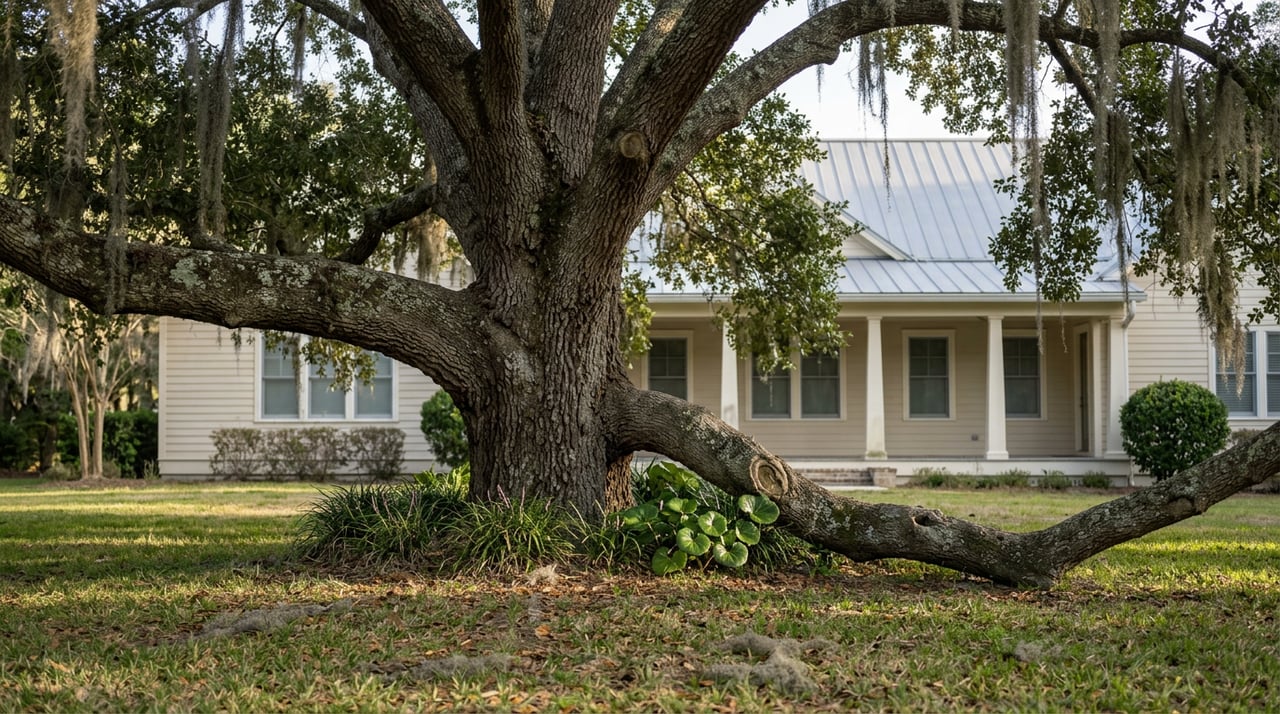
A couple bought a corner lot at Arnold and Demere roads on the south end of St. Simons Island with a plan that sounds familiar to anyone shopping for buildable ground on the island: clear it, design a house, build. At the center of the parcel stood a live oak that had been growing for roughly two hundred years, wide enough and old enough that longtime islanders remembered it as the "hiring tree," the spot where day laborers once stood in its shade waiting to be picked up for hourly work. The couple got as far as owning the land. They never got as far as cutting the tree. In June 2014, they sold the parcel to the St. Simons Land Trust at less than market value, specifically so the oak would never come down.
Nobody made them do that. What stopped them was the same thing that stops a lot of people on this island once they stand under a tree that old: the math doesn't work out to demolition. But the story matters for a different reason. It's a preview of what the county has since written into law for the trees that don't get lucky enough to have a conflicted owner standing over them with a chainsaw and second thoughts.
The assumption almost every buyer makes
If you buy a lot, you own what's on it. That's true of the house, the shed, the fence line. It is only partly true of the live oaks.
St. Simons Island is the only jurisdiction in Glynn County with its own tree canopy preservation rule written into the zoning code. Sea Island, Jekyll Island, and Brunswick don't have it. Section 624 of the Glynn County zoning ordinance applies to St. Simons alone, and its stated goal is blunt: keep at least 50 percent of the island's tree canopy standing after any development, measured against what's called open soil area, the ground left undisturbed and available for root growth. The county's own math holds that every square foot of preserved open soil produces roughly two square feet of canopy overhead, which is how a ground-level number turns into a canopy percentage.
For commercial or industrial development, and residential lots of one acre or more, the rule requires a Tree Plan approved by the Islands Planning Commission before a building permit is even issued, as Glynn County explains. Those projects have to keep 25 percent of the land they intend to develop open and dedicated to growing trees, with a minimum of 12 large-canopy trees either planted or retained, and no single open area smaller than 400 square feet, as The Brunswick News reports. The species get sorted into large, medium, and small canopy categories using the county tree board's own list, and a preserved specimen tree earns extra credit toward the requirement, on the theory that a mature oak is worth more standing than a dozen saplings planted to replace it.
That's the developer-facing version of the rule. Most buyers of an existing single-family home never touch it. What they do run into is smaller, and it's the part that catches people off guard.
The exemption that doesn't cover what you actually want to do
Here's the detail worth sitting with before you assume the ordinance doesn't apply to you. Standard residential lots of 6,000 square feet or larger, but under one acre, are exempt from most of the ordinance. That's the overwhelming majority of single-family lots on St. Simons. If you're buying a typical home on a typical lot, you are not going to be asked to file a Tree Plan with the Islands Planning Commission before you renovate the kitchen or add a screened porch.
But that exemption has a carve-out, and it's the one thing homeowners are most likely to actually want: residential landowners still have to get permission before removing a mature live oak. The lot-size exemption covers the paperwork burden of development review. It does not cover the tree itself.
| What's exempt | What still requires approval |
|---|---|
| Standard residential lots of 6,000 sq ft or larger, but under one acre, from filing a full Tree Plan | Removing a mature live oak, on any residential lot regardless of size |
| Routine additions, interior renovation, non-tree-affecting permits | Commercial or industrial development, or residential lots of one acre or more |
| Small landscaping and understory clearing | Anything that disturbs a tree the Tree Advisory Board has designated Heritage |
This is the gap that trips up buyers who are picturing a pool deck where a live oak currently stands, or an addition that needs the footprint a canopy is currently occupying. The lot might be well under an acre. The homeowner might never file anything with the Islands Planning Commission for the rest of the house. But the tree itself still needs a yes from the county before it comes down, and that conversation happens on the county's timeline, not the renovation contractor's.
Heritage Trees don't ask the new owner's permission
There's a further layer that matters even more at resale. The Tree Advisory Board can designate a tree as a Heritage Tree, with the property owner's consent at the time. Once that designation is in place, the tree cannot be cut or removed without the Board's permission, and that restriction doesn't expire when the house sells. A current or subsequent owner can petition the Board to have the designation lifted, but until that happens, the tree's protected status travels with the deed, not with the person who originally agreed to it.
In practice, this means a buyer can inherit a legal restriction on a specific tree in the yard without ever having been part of the conversation that created it. If you're under contract on a home with a significant live oak and nobody has mentioned whether it carries a Heritage designation, that's worth asking before closing, not after you've already drawn up landscaping plans that assume the tree is negotiable.
How to actually check before you buy or before you build
The good news is that this isn't a guessing game. The Golden Isles Fund for Trees maintains a searchable, GPS-tagged database of live oaks across Glynn County, built in partnership with the county's GIS office. Many mature oaks on and around St. Simons carry a physical identification tag, and the database lets you look up a tree's history, approximate age, girth, and location by that tag number. If a property you're considering has a tagged specimen, it's worth pulling up before you finalize any renovation plans that assume you can work around it, or through it.
For anyone who wants to see what a genuinely protected specimen looks like without stepping onto private property, the Trustee George Live Oak, tagged number 166, stands at 100 Mallery Street near the pier, a tree whose age reaches back to Georgia's earliest colonial period under the Trustees who governed before it became a Crown colony. It's a public, walkable reminder of what the island considers worth keeping upright for another two hundred years.
Before you write an offer with renovation plans attached, or before you list a home with a mature canopy as part of its appeal, a few questions are worth asking directly:
- Does the property have a Tree Plan on file with the county, and does it note any protected or specimen trees
- Is any tree on the lot designated as a Heritage Tree, and if so, is that designation searchable through the Golden Isles Fund for Trees database
- If your plans include a pool, addition, or new structure that would require removing a mature live oak, have you confirmed with the county's Tree Advisory Board process before you budget for it
- If you're selling a home with a canopy you know buyers will love, is that canopy part of what you're pricing in, since a documented, healthy specimen tree is not just landscaping on this island, it's part of the asset
None of this is meant to make the island sound harder to build on than it is. Most renovations proceed exactly as planned. Most additions never touch a canopy tree at all. But the couple who walked away from Arnold Road understood something that the ordinance later formalized: on St. Simons, the oak in the yard is often the reason someone bought the lot in the first place, and it deserves the same due diligence as the survey, the septic, or the flood zone.
A few questions worth asking directly
Does the tree ordinance apply if I'm just adding a small addition to an existing house? Most single-family renovations on lots of 6,000 square feet or larger but under one acre fall outside the full Tree Plan requirement. The exception is any work that would remove a mature live oak, which still requires county permission regardless of the size of the addition.
Who decides if a tree gets Heritage status, and can that ever be undone? The Tree Advisory Board designates Heritage Trees with the property owner's consent at the time. A current or future owner can petition the Board to remove the designation, but the tree stays protected until that petition succeeds.
Is there a way to check a tree's status before I make an offer? The Golden Isles Fund for Trees keeps a public, tag-searchable database of live oaks across Glynn County, built with the county's GIS office, which is a reasonable first stop before assuming a canopy tree is simply part of the landscaping.
If you're weighing a purchase on St. Simons Island with a renovation or new build in mind, or you're getting ready to list a home where a mature canopy is part of the story, it helps to work through these details before they become a surprise mid-contract. Mackay Cate has spent a lifetime on these islands and can walk you through what a given lot's tree history actually means for your plans. Reach out for a free home valuation and a straight answer on what you're working with.
This article is general information, not legal, tax or financial advice. Consult a qualified professional about your situation.